


[ad_1]
Grape juice and whole grapes are put to the test for brain function, including cognitive decline in early Alzheimer’s.
In 2010, the first controlled trial was published that examined how the brain responds to grape juice. It helped aged rats, but what about people? “Concord grape juice supplementation improves memory function in older adults with mild cognitive impairment”—or so says the title. The problem is that the study was funded by Welch’s, and, though the authors claim they have no financial interest in the outcome, that seems disingenuous. I mean, do they think Welch’s would ever fund them again if they found grape juice wasn’t good for you? And, indeed, that title is a bit of industry spin. I’m sure that’s what they wanted to find.
Older adults with memory decline (but not dementia) were randomized into a placebo-controlled, double-blind trial with Concord grape juice versus a similarly looking and tasting Kool-Aid type of drink with the same calories and same sugars. That’s a solid study design. And, berries have those wonderful polyphenol phytonutrients, which have anti-inflammatory and antioxidant properties, so it certainly could help brain function and it did seem to help with verbal learning, as you can see in the graph below and at 1:21 in my video Friday Favorites: Benefits of Grapes for Brain Health.
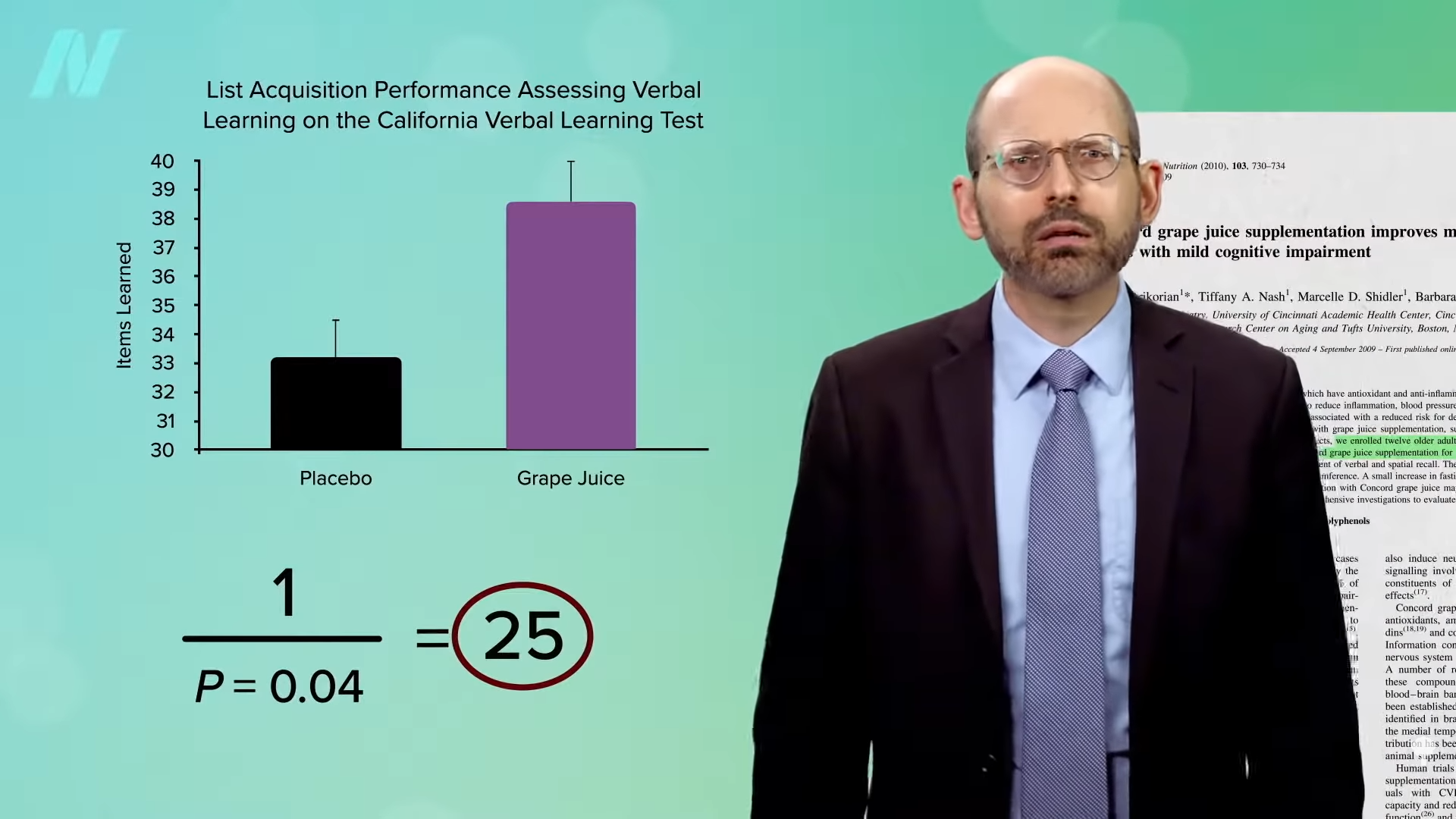
The odds you’d get such notable results just by chance are like 1 in 25, whereas the higher recall scores are not considered to be statistically significant, since even if there wasn’t an effect, you might get those kinds of results by chance 1 in every 8 or 10 times you’d run the experiment, as shown in the graph below and at 1:38 in my video. And, by convention, we like at least 1 in 20—a p-value of 0.05 or less—especially if we’re looking at multiple outcomes, which increases the likelihood that something will pop up as a fluke. The bottom line is that we’re less confident in these memory outcomes. If this study hadn’t had industry funding, I imagine it would be titled more accurately. Perhaps “Concord grape juice supplementation improves verbal learning in older adults with mild cognitive impairment”—which is still an important finding, and we have the Welch’s corporation to thank for it. Without industry funding, a study like this might never get done.
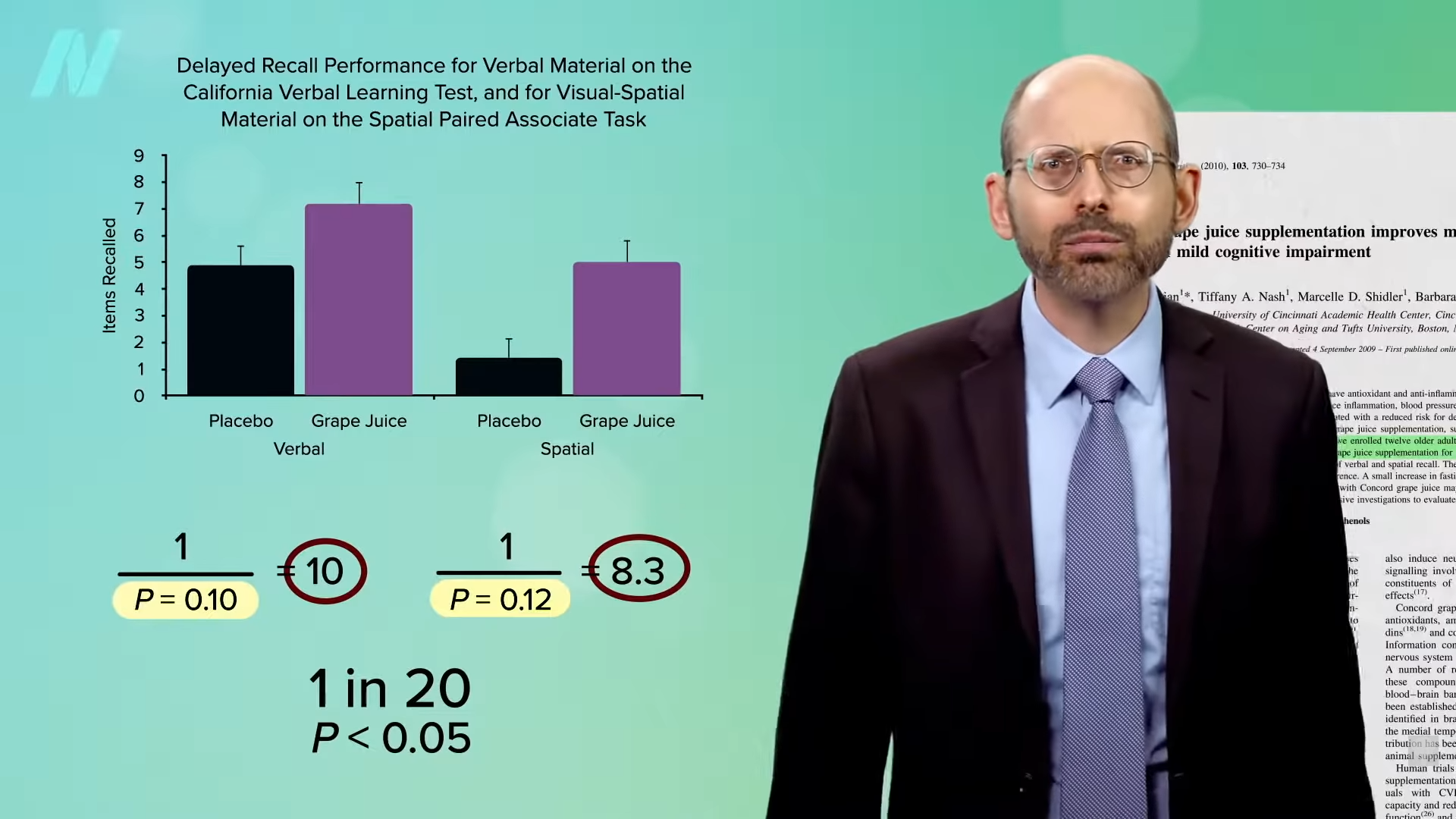
The findings suggest that drinking grape juice is superior to drinking a grape Kool-Aid type of beverage, not necessarily for helping memory, but maybe for helping with learning. When the study was repeated, though, it did seem to help one measure of memory, but no benefit was found for verbal learning, even when using the same test as before, which calls the previous results into question. So, we’re left uncertain about what effects, if any, grape juice has on the aging brain.
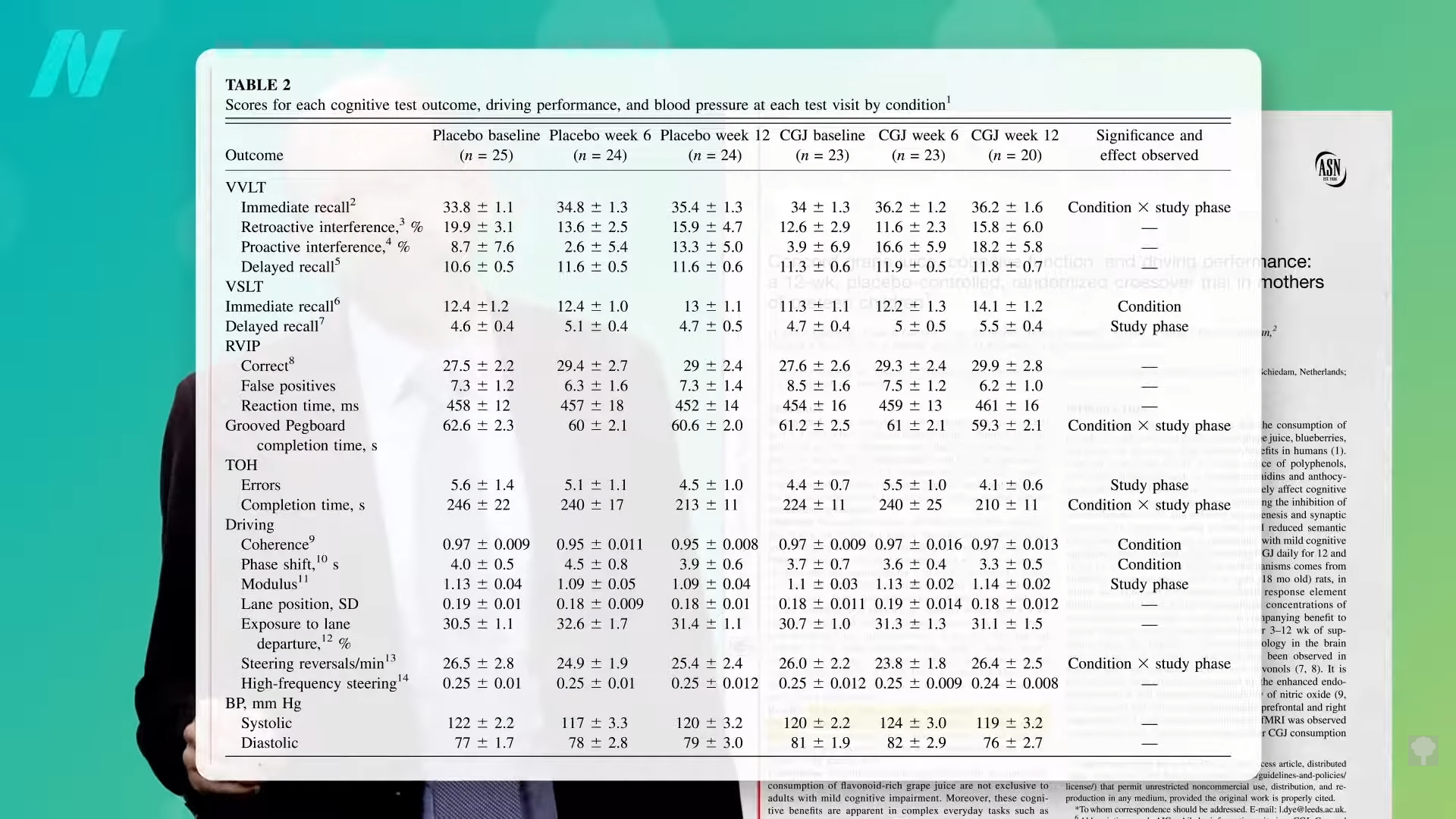
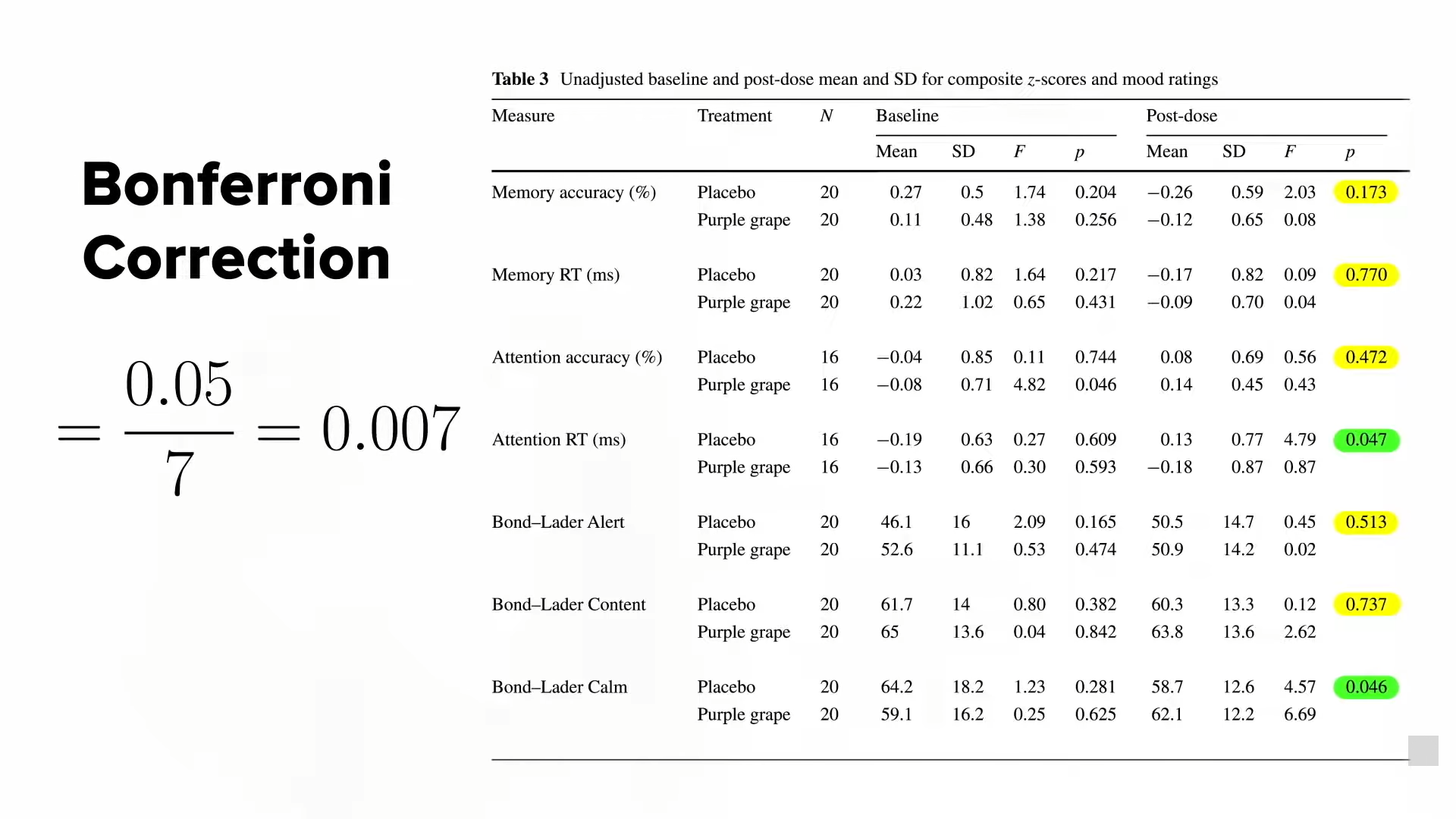
What about the brains of middle-aged mothers? The Welch’s-funded researchers noted significant improvements in one measure of memory and driving performance as measured in a fancy driving simulator, suggesting you might be able to stop a dozen yards earlier on the highway after drinking grape juice than if you had instead had a grape Kool-Aid type of drink. I do like how they tried to translate the cognitive effects into more meaningful metrics, but it’s important to acknowledge, as they did, that no effects were found for the majority of cognitive consequences. And, when you study 20 different outcomes, the odds are pretty good that you’d just get a statistically significant result or two by chance, as you can see below and at 3:33 in my video.
The latest study involved giving a single dose of a cup of purple grape juice or white grape juice (to which flavor and color had been added to disguise it) to young adults with an average age of 21. In this way, researchers could see if there’s something special about those deep purple polyphenol pigments in Concord grape juice. Their findings? They got the same kind of results: two cognitive measures just reaching statistical significance, but that’s out of seven different outcomes, as you can see below and at 4:12 in my video. So, instead of a p-value of 0.05 as the cut-off for significance, we’d really like to see closer to 0.007, and none hit that. Maybe it’s because they didn’t use whole food like in that blueberry study I profiled before.
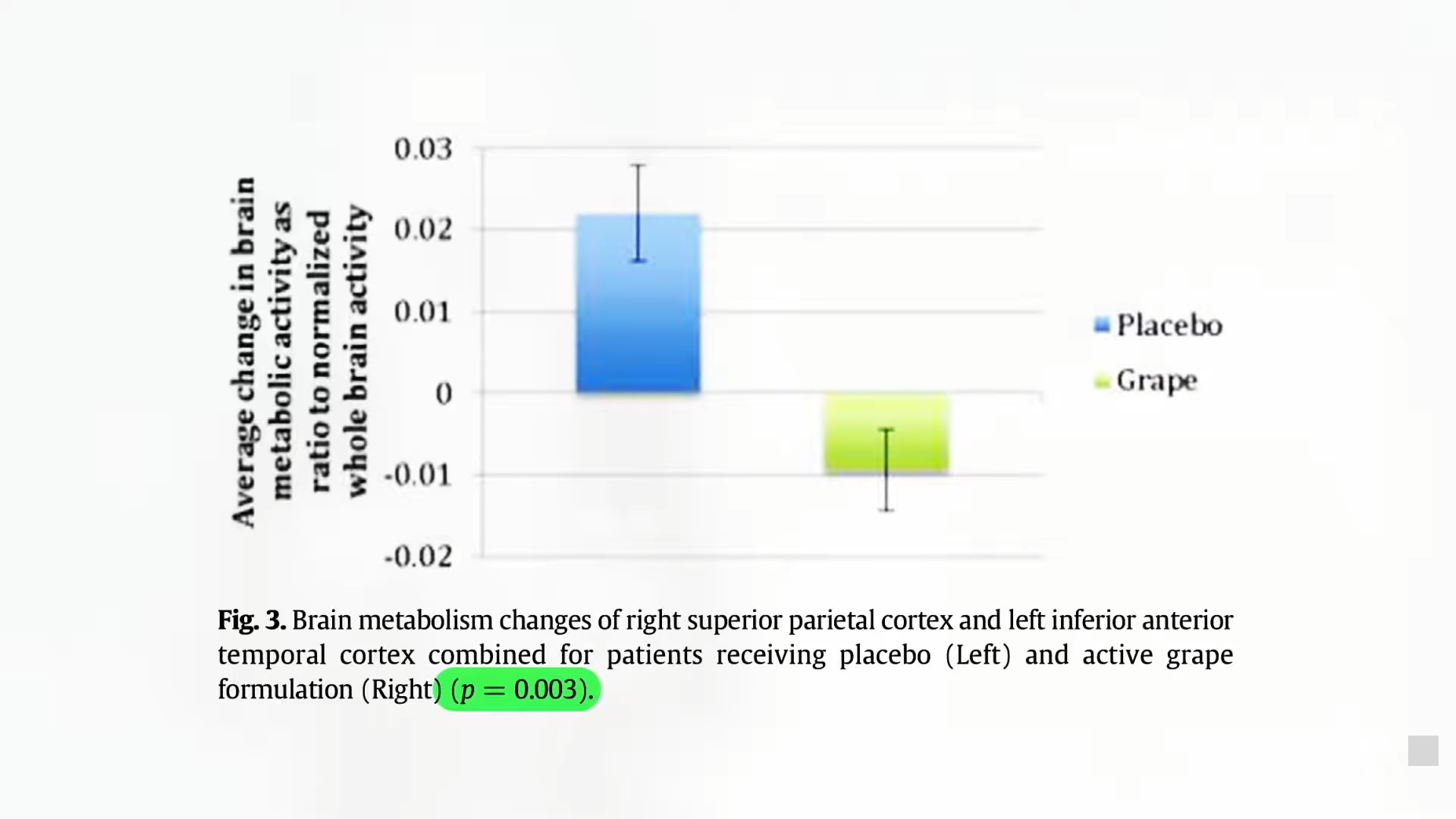
There was a study that looked at actual grape consumption by utilizing freeze-dried grape powder to capture the whole food (instead of just the juice) versus a sugar-matched placebo. The researchers used PET scans to track changes in brain metabolism associated with early Alzheimer’s in a group of older adults already suffering from mild cognitive decline. Although the changes couldn’t be picked up on neuropsychological testing, in those early-stage Alzheimer’s regions, the placebo group continued to worsen, but the grape group “was spared such decline,” suggesting a protective effect of grapes. You can see these points illustrated in a graph and brain mapping pictures below and from 5:11 in my video. You can see locations where brain metabolism declined after eating six months of placebo grapes (colored red in the video), compared to the level of decline in a brain after six months of eating actual grapes.
When commercial entities fund studies, it’s more for marketing purposes than science. That doesn’t necessarily mean the findings are invalid, but you do have to pay special attention to things like the framing of the research question, the experimental methods, statistical analysis, biased interpretation of results, or spin.
The blueberry video I mentioned is Flashback Friday: Benefits of Blueberries for the Brain. You may also be interested in the Benefits of Blueberries for Mood and Mobility.
What else might help protect brain function? Check out related posts below.
Click here to get The Oxridized Cholesterol Strategy at discounted price while it’s still available…

[ad_2]

14 Comments
Your article helped me a lot, is there any more related content? Thanks!
**mindvault**
mindvault is a premium cognitive support formula created for adults 45+. It’s thoughtfully designed to help maintain clear thinking
**breathe**
breathe is a plant-powered tincture crafted to promote lung performance and enhance your breathing quality.
Gave 199winbet4 a spin, and it’s alright! Nothing crazy, but a solid, reliable option. Good enough to kill some time and maybe win a few bucks. Take a peek at 199winbet4.
Downloading the 88vin app from here. Hoping it’s the official one and easy to install. Fingers crossed! Grab it here: 88vinapp.
Need the ph646 app? ph646download seems like the place to grab it. Simple and fast to get your game on. Get after it at ph646download.
Just spun some reels on 88vin.stone. UI is solid, payouts aren’t too shabby. Definitely worth a punt. 88vin.stone
188bet88betbongda, the name’s a mouthful, but I see they focus on football betting. If you’re into betting on the beautiful game, maybe give 188bet88betbongda a looksee.
**backbiome**
backbiome is a naturally crafted, research-backed daily supplement formulated to gently relieve back tension and soothe sciatic discomfort.
**vivalis**
vivalis is a premium natural formula created to help men feel stronger, more energetic, and more confident every day.
**balmorex pro**
balmorex is an exceptional solution for individuals who suffer from chronic joint pain and muscle aches.
**synadentix**
synadentix is a dental health supplement created to nourish and protect your teeth and gums with a targeted combination of natural ingredients
**alpha boost**
alpha boost for men, feeling strong, energized, and confident is closely tied to overall quality of life. However, with age, stress, and daily demands
**finessa**
Finessa is a natural supplement made to support healthy digestion, improve metabolism, and help you achieve a flatter belly.